UPCOMING EVENTS:
Join us on Thursday, August 13 at 12pm PT / 3pm ET / 4pm AT for Organizing Climate Futures Webinar #2 – BEYOND REPORTS!
Join Indigenous Climate Action, Research for the Frontlines and UVic’s Transformative Climate Action program for Organizing Climate Futures, a three-part speaker series that brings together Indigenous organizers and land defenders from across so-called Canada to explore how to make just, livable futures more possible.
Too much of today’s climate discourse and climate action continues to be shaped by colonial understandings and false, corporate solutions. This series of conversations will help counter that.
This event is the second of three conversations in the series and will take place on Thursday, August 13 at 12pm PT / 3pm ET / 4pm AT.
The theme of this session is Beyond Reports: Exploring Indigenous Aesthetic Practices as Legitimate Forms of Climate Research and Political Analysis. Together, we will explore how Indigenous aesthetic practices (including storytelling, ceremony, etc.) can serve as powerful forms of climate research, political analysis and knowledge sharing.
ASL interpretation will be provided.
You can register here: https://us06web.zoom.us/meeting/register/h1YSGgIeTBet2GbajBX-AQ
Speakers include:
Riley Yesno is a queer Anishinaabe scholar, writer, and commentator from Eabametoong First Nation. She has been a contributor and commentator for some of the largest media outlets in Canada and the world. Riley has also travelled the globe speaking at internationally renowned institutions and events, including the UN climate negotiations, the Stockholm Forum on Gender Equality, TEDx stages, and many others. She instructs courses at the University of Toronto and Toronto Metropolitan University and is a Ph.D. candidate at the University of Toronto, where she studies Indigenous politics and is a Vanier Scholar.
Aya Clappis is an afro-indigenous person of somali and nuučaanuł (huu-ay-aht) lineage who often daydreams of revolution, tender moments, liberation, and the shorelines from which they emerge. They enjoy creative expression through writing poetry, fiction, and analog film. They hold a BA in political science and minor in the human dimensions of climate change from the university of victoria. Their current work in the realm of climate change and emergency management seeks to reimagine and co-create solutions to complex issues with sovereignty and caretaking at the fore. They currently reside in Haida territory.
PAST EVENTS:
Watch this conversation about what land defense campaigns teach us about the fight for just and livable climate futures. Featuring Sleydo’ Molly Wickham, Jesse Stoeppler, and Tia Kennedy.
Why Environmental Justice Movements must stand with Palestine. A Teach-in with Dr. Rania Masri
On May 28, 2024, Research for the Front Lines, Keepers of the Water, the Social Justice Centre, Climate Action Network (CANRac) and the Climate Justice Organizing Hub hosted this Teach-in with Dr Rania Masri on the critical question of Why Environmental Justice Movements Must Stand With Palestine.
Good Relations: Consent, Reciprocity and Ethics in Indigenous-led Research, with speakers Elizabeth Fast, Marina Johnson-Zafiris, and Ojistoh Horn.
Monday, April 22, 2024, Research for the Front Lines, Indigenous Climate Action and Shift Centre for Social Transformation hosted Good Relations: Consent, Reciprocity and Ethics in Indigenous-led Research, with speakers Elizabeth Fast, Marina Johnson-Zafiris, and Ojistoh Horn.
Indigenous Food Sovereignty & Community-led Research
On March 20, 2024, we hosting an event on Indigenous Food Sovereignty & Community-led Research – A conversation with Tiffany Traverse and Waba Moko (Shannon Chief), and moderated by Jaimie Vincent
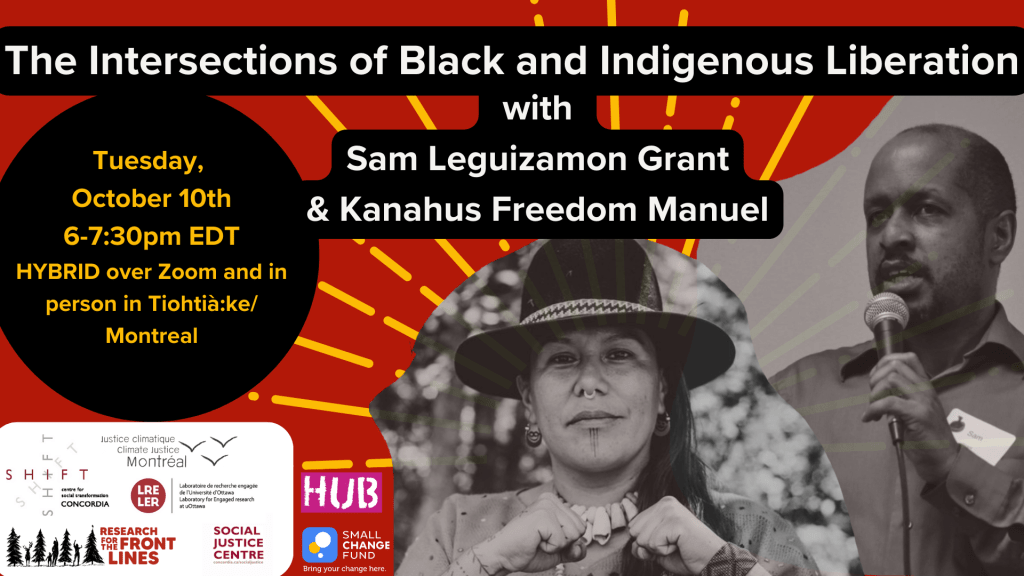
The Intersections of Black and Indigenous Liberation
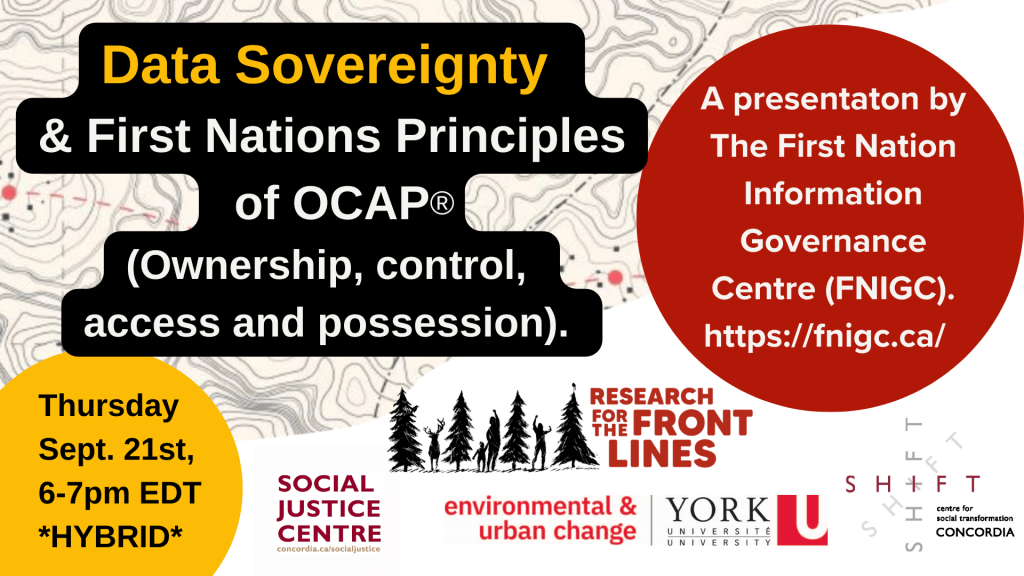
DATA SOVEREIGNTY & First Nations Principles of OCAP
We do not have a recording of this event but here are some relevant and useful resources:
- The First Nations Information Governance Centre. A First Nations Data Governance Strategy: Executive Summary. Ottawa, ON: The First Nations Information Governance Centre; 2020. https://drive.google.com/file/d/13eWYgD5kNFiLowZ8ExnGz9LoJL7Expsj/view?usp=drive_link
- First Nations Information Governance Centre. Barriers and Levers for the Implementation of OCAPTM. International Indigenous Policy Journal 2014;5:. https://doi.org/10.18584/iipj.2014.5.2.3.
- First Nations Information Governance Centre. Strengths-Based Approaches to Indigenous Research and the Development of Well-Being Indicators. Ottawa, Ontario; 2020. https://fnigc.ca/wp-content/uploads/2021/05/FNIGC-Research-Series-SBA_v04.pdf
- The First Nations Information Governance Centre. A First Nations Data Governance Strategy. Ottawa, ON: The First Nations Information Governance Centre; 2020. https://fnigc.ca/wp-content/uploads/2020/09/FNIGC_FNDGS_report_EN_FINAL.pdf
- Assembly of First Nations Quebec-Labrador – AFNQL. First Nations in Quebec and Labrador’s Research Protocol. Wendake; 2014. https://cssspnql.com/en/produit/first-nations-in-quebec-and-labradors-research-protocol/
- Ownership, control, access and possession (OCAPTM): The path to First Nations information governance. https://fnigc.ca/wp-content/uploads/2020/09/5776c4ee9387f966e6771aa93a04f389_ocap_path_to_fn_information_governance_en_final.pdf.
- Research Toolkit from the Native Women’s Association of Canada (p31) https://www.nwac.ca/assets-knowledge-centre/SPARK-NWAC-CRGBA-TOOLKIT-2022-EN1-3-Feb-15-2022.pdf
Speaking-in-Relation: A Training on Effective Communication
On August 17, 2023, we hosted a training with Dr. Sam Leguizamon Grant. He provided us with inspiring and heart opening tools for refection and connection, helping us learn to communicate in ways that build strong collaborations and resilient communities. You can watch and share the recording below.
FROM JARGON TO ACTION
On July 11, 2023, we hosted a training led by Tom Liacas and Kenzie Harris of the Global Grassroots Support Network. We learned many concrete skills for translating academic research to accessible, actionable information for communities and movements involved in transformative struggles. You can watch the recording below.
Here are the slides that were used: https://docs.google.com/presentation/d/1btibxbdAuKGIPPW3kTA2T0l0IEBpP-4Z3G8FYdGDDRE/edit?usp=sharing
Blueprints for Change guides:
https://blueprintsfc.org/guides/
Climate Justice Organizing HUB wikis:
Anglo
https://en.wiki.lehub.ca/index.php/Main_Page
Franco
https://fr.wiki.lehub.ca/index.php/Accueil
Global Grassroots Support Network guides on Commons Library:
https://commonslibrary.org/collection/ggsn/
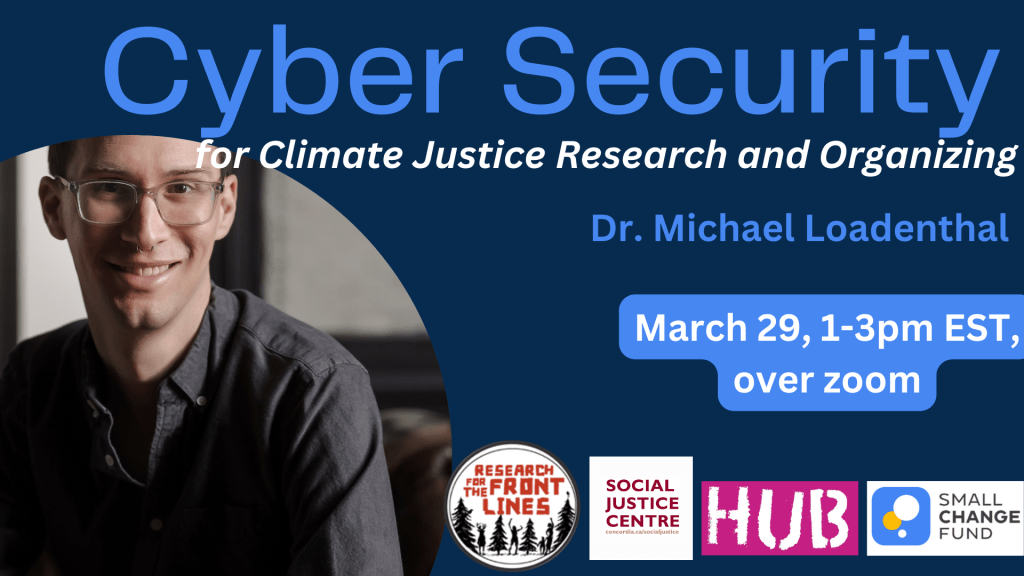
DIGITAL SECURITY with Micheal Loadenthal
On March 29, from 1-3 pm EST, R4FL hosted a training led by Dr. Michael Loadenthal, a postdoctoral researcher at the Center for Cyber Strategy and Policy, within the School of Public and International Affairs, at the University of Cincinnati. He concurrently serves as the founder and Executive Director of the Prosecution Project, tracking cases of political violence in the US courts, and a Research Team Lead with Princeton University’s Bridging Divides Initiative, which mitigates localized political violence. Here’s the Facebook event
Settler Colonialism 101 with Chelsea Vowel
Investigative Research 101 with Tim Groves
Click here to access Tim’s powerpoint presentation.
Indigenous Research Methods
Co-presented by Indigenous Climate Action, this event featured Professor Deborah McGregor of the Indigenous Environmental Justice Project, and Canada Research Chair in Indigenous Environmental Justice at Osgoode Hall Law School, York University.
Learn about the rich, diverse, and dynamic world of Indigenous approaches to research and how they are contributing to the fight for climate and environmental justice across so-called Canada.
The training session was facilitated by Indigenous Climate Action’s Decolonizing Climate Policy research team.
Movement-led Research Resources
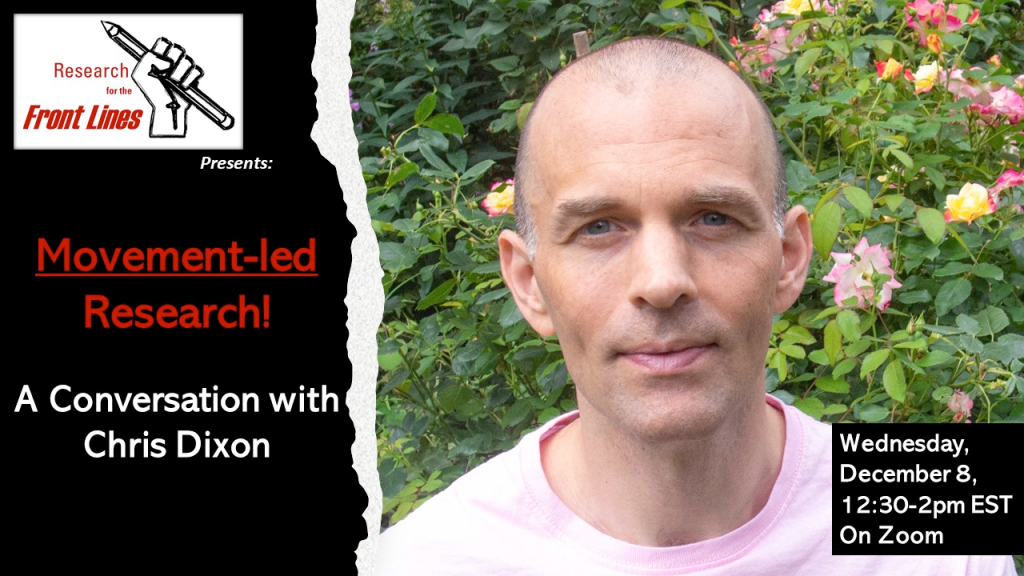
- Click here to access the recording of Chris Dixon’s workshop on movement-led research
- Click here to access the workshop transcript
Access to Information Resources